
Blepharoplasty
is eyelid surgery designed to improve the vision and overall cosmetic appearance
of the eyelids. This surgery is one of the most common cosmetic procedures performed
in the country today. Blepharoplasty is also one of the most effective means
of restoring vision in patients with excessive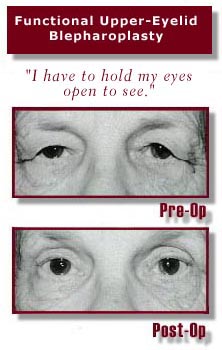 hooding of the upper eyelids. Patients who desire blepharoplasty generally fall
into two broad categories.
hooding of the upper eyelids. Patients who desire blepharoplasty generally fall
into two broad categories.
The
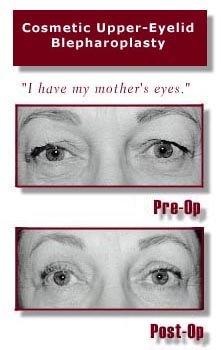
first category includes people who wish to accentuate their eyes,
improve their overall appearance, and reduce the tired look of excess and redundant
eyelid tissue. People in this category are good candidates for cosmetic blepharoplasty.
In
the second category, patients complain of visual difficulties related
to heavy upper eyelid tissue. Often the skin of the upper eyelids rests across
the eyelashes and blocks the vision. Patients in this category notice improved
vision by elevating the flaps of skin with their fingertips and are candidates
for functional blepharoplasty.
COSMETIC BLEPHAROPLASTY
The
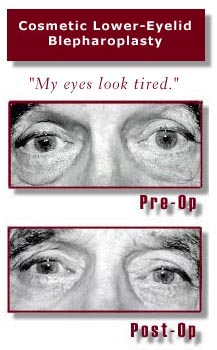
goals of cosmetic blepharoplasty are to improve the appearance of
the eyelids and the patient's overall sense of well-being. Last year in the
United States over 60,000 cosmetic blepharoplasties were performed. The frequency
of this procedure is increasing rapidly. Patients who desire cosmetic eyelid
surgery often express the wish to restore a more rested and youthful appearance
to their eyelids.
The
lower eyelid blepharoplasty is always considered cosmetic surgery.
The removal of lower eyelid fat is performed through the inside of the lid and
via a transconjunctival approach. This approach minimizes many of the complications
seen with older blepharoplasty techniques. The transconjunctival lower eyelid
blepharoplasty is probably the most common cosmetic procedure performed on men
today.
An
oculoplastic surgeon has special expertise and insight regarding
eyelid surgery that is unavailable elsewhere. It is important to remember the
eyelids are an integral component of the visual system, and an improvement in
appearance must not be achieved by compromising the critical role of the eyelids
in maintaining ocular health and comfort.
FUNCTIONAL BLEPHAROPLASTY
Restoring
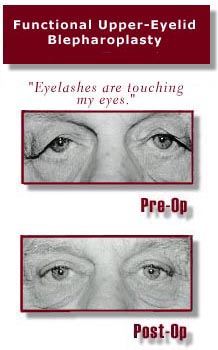
vision is the primary goal of functional blepharoplasty.
Patients undergoing functional blepharoplasty report improved vision, less eye
strain, and also improved appearance. A consultation for functional blepharoplasty
begins with an eye exam. Skin of the upper eyelids resting across the eyelashes
is a clue that the vision may be compromised by the eyelid configuration. A
visual field test will often confirm significant visual field loss. Formal visual
field testing is performed both with the eyelids in a natural position and with
the excess skin held off the eyelids. Most major insurance companies will pay
for surgery when excess eyelid skin produces a greater than 50% loss of the
superior field of vision.
Improving
vision is only one of the reasons for blepharoplasty to be performed.
In some cases, excess upper eyelid skin can push eyelashes into contact with
the cornea and cause eye pain. Many people with intractable eyelid inflammation
can be helped by removing excess upper eyelid skin, since bacteria and debris
can be trapped underneath the folds of tissue.
Functional blepharoplasty can significantly improve
vision and enhance periocular health in a wide variety of patients.
LASER BLEPHAROPLASTY
The
use of lasers in ophthalmology and specifically oculoplastic surgery
has been common over the last ten years. Recently a combination of improved
technology and increased media interest has raised public awareness of laser
eyelid surgery. New machines have been developed to deliver CO2
laser energy in a continuous wave and ultrapulsed mode. This laser is quite
effective and useful in the performance of blepharoplasty.
The
application of CO2 laser technology to eyelid
surgery has several advantages. A patient who has a laser blepharoplasty can
expect less bruising, and a more rapid recovery time when compared to conventional
blepharoplasty.

WHERE IS BLEPHAROPLASTY
PERFORMED?
Blepharoplasty
can be performed both in the physician's office and in the hospital
operating room. The surgery often lasts less than an hour and produces minimal
pain. Following surgery, ice is applied to the eyelids for 48 hours. A prescription
for pain medications and eye ointments are given at the time of surgery. At
no time are patches placed on the eyes, and the vision is not compromised.
Patients
can expect a minimal to moderate amount of bruising and swelling for
seven to ten days after surgery. A complete recovery takes approximately six weeks.
Patients often return to work several days following the operation. A week following
blepharoplasty surgery, contact lenses and eyelid makeup can be worn. Patients
are advised to avoid doing vigorous physical exercise for one week following surgery.
copyright
 1998
John A. Long, M. D., F.A.C.S.
1998
John A. Long, M. D., F.A.C.S.