PTOSIS

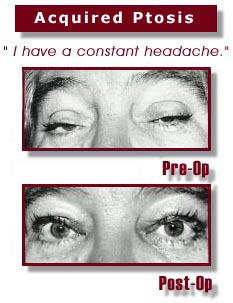
Ptosis is a malposition of the upper eyelid which causes functional vision loss. The upper eyelid margin droops over the eye and produces a loss of the superior field of vision. There are two major types of ptosis: congenital and acquired. Congenital ptosis is present from birth, and often is associated with poor lid function and an absent eyelid crease. Children with congenital ptosis often have arched eyebrows and must keep their chins elevated in order to see out from underneath their eyelids. Acquired ptosis is quite common and is often seen in older patients. Acquired ptosis is most often caused by a stretching of the levator muscle in the eyelid. The levator muscle is the muscle primarily responsible for elevating the eyelid, and when the tendon is stretched, the eyelid can become ptotic. Trauma, aging, contact lens use, and cataract surgery can all cause a stretching of the levator tendon leading to ptosis.
Other causes of acquired ptosis are much less common. Nerve dysfunction due to trauma or myasthenia gravis can also lead to a weakened levator muscle, which can result in ptosis.
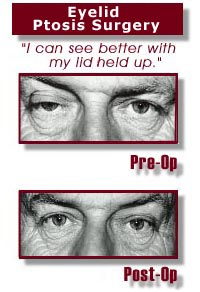 The hallmarks of acquired ptosis caused by stretched levator tendon is good levator function and an elevated eyelid crease. Patients will often comment that their vision is much better with their eyelid margins manually elevated. Patients will also complain about periocular headaches and fatigue which is caused by the extra effort required to hold their eyelids open.
Ptosis is a functional disability which is covered by all major insurance companies. The eyelid malposition is functional in nature, and while the results of surgery often lead to an improvement in appearance, the overall goal of surgery is to restore visual function.

WHERE IS SURGERY PERFORMED?
Ptosis surgery is usually performed in a hospital operating room, since it is a functional problem. This surgery can last between 15 and 30 minutes and is almost always performed on an outpatient basis. Patients are kept comfortable during surgery with local anesthesia and intravenous sedation. With patients' cooperation, the eyelid height and contour can be adjusted in the operating room for the best possible outcome.
Ptosis surgery can be performed through an incision in the eyelid skin or through an incision on the inside of the eyelid. Individual preoperative testing will determine the best surgical approach for each individual patient. With ptosis surgery, absorbable sutures are almost always used. These sutures do not need to be removed following the operation.
WHAT TO EXPECT
Ptosis surgery usually produces a minimal to moderate amount of bruising and swelling. The eyelids often feel tight and stiff for one week. For the first 48 hours after surgery a slight blurring of the vision can be expected due to the swelling and the use of postoperative antibiotic ointments. There is minimal postoperative pain. It is not unusual for patients to return to work several days following the operation. Contact lenses and makeup can be worn one week following surgery. Vigorous physical exercise is not advised during the first week.
copyright
 1998 John A. Long, M. D., F.A.C.S.
The information contained in this web site is not intended as a substitute for individual medical advice. Visitors to our web site are strongly encouraged to regularly consult a physician in matters relating to his or her health and particularly with respect to any symptoms that may require futher medical attention or diagnosis on the part of a physician.